
Data
Understand the information required to assess the organisation and support strategic decisions.
Xirocco
Xirocco creates one connected strategic context so leaders can see how decisions, dependencies and priorities fit together.
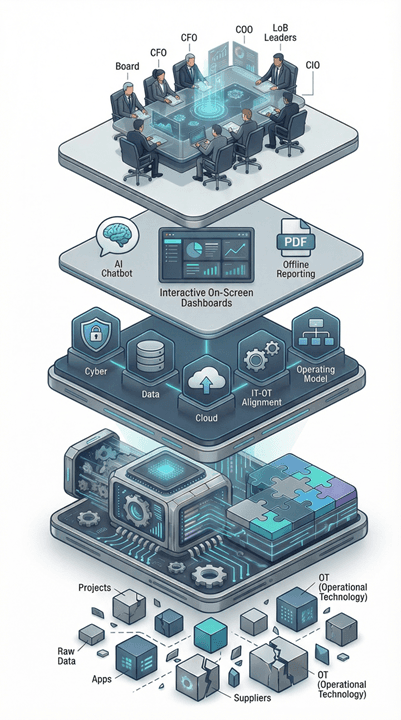
Most organisations already have substantial amounts of information. The problem is that it is rarely connected in a way that supports strategic decision-making. Important context may be spread across:
Strategy presentations
Architecture repositories
Application inventories
Supplier records
Risk registers
Project portfolios
Investment plans
Cybersecurity assessments
Operational technology information
Spreadsheets
Workshop outputs
Individual teams
People's heads
Xirocco creates a connected strategic foundation across those areas. The aim is not simply to put more information in one place. The aim is to make the relationships visible.
Xirocco is designed around the principle that technology strategy should begin with what the organisation is trying to achieve. That means starting with:
Business priorities
Mission
Strategic outcomes
Capabilities
Organisational change
and working backwards into:
Applications
Data
Infrastructure
Cybersecurity
Operational technology
Architecture
Suppliers
Operating model
Investment
Transformation activity
This creates a direct connection between business ambition and technology action.
A strong technology strategy should make it possible to trace why a technology decision matters. Xirocco helps create a "Golden Thread" between:
Business ambition → capabilities → technology → investment → change
This allows leaders to understand questions such as:
Which capabilities are most important to strategy?
Which applications support those capabilities?
Which technologies create constraints?
Which investments address the most important weaknesses?
Which projects contribute to strategic priorities?
Which changes have little connection to what the organisation is trying to achieve?
The objective is to make the strategic rationale behind technology choices visible.
For many organisations, technology can no longer be understood through IT alone. Business services may depend on combinations of:
Enterprise applications
Cloud platforms
Infrastructure
Networks
Operational technology
Industrial systems
Suppliers
Data
Cybersecurity controls
Xirocco can connect relevant business, IT and OT context into one strategic view. This is particularly important where resilience, transformation, cybersecurity or operational performance depend on relationships across traditional organisational boundaries.
Xirocco supports a structured view of enterprise strategy through the Xirocco Strategy Framework. The framework brings together six connected areas.
Understand the information required to assess the organisation and support strategic decisions.
Connect technology activity to:
Business objectives
Mission
Strategic priorities
Capabilities
Desired outcomes
Assess the current technology environment and identify strengths, weaknesses and constraints.
Define how technology should evolve to support the organisation's future direction.
Understand the organisational capabilities, governance, skills, roles and ways of working required to execute the strategy.
Connect required change to investment priorities, dependencies and sequencing. These areas are not treated as separate exercises. They form a connected strategic model.
A single maturity score rarely explains why an organisation is struggling. Xirocco supports a more comprehensive diagnostic view. Depending on the problem being addressed, the current state can be examined across areas such as:
Applications
Data
Infrastructure
Cybersecurity
Operational technology
Suppliers
Architecture
Operating model
Skills
Governance
Investment
Strategic alignment
This helps move beyond a superficial assessment of whether something is "good" or "bad". The more useful questions are:
Why does this weakness matter?
Which business capability does it affect?
What does it depend on?
What should be addressed first?
What would happen if it were left unchanged?
The value of Xirocco lies in the relationships between information. For example:
Business Capability → Application → Technology → Supplier → Risk
or:
Strategic Objective → Capability Gap → Investment → Programme → Dependency
or:
Critical Service → OT Asset → Network Dependency → Cyber Exposure → Resilience Impact
When those relationships are visible, strategic questions become easier to investigate.
Technology decisions are more useful when leaders can see what they enable. Xirocco helps connect technology to:
Strategic objectives
Business capabilities
Customer outcomes
Operational priorities
Transformation programmes
Risk reduction
Organisational resilience
This helps shift the conversation from:
What technology do we have?
to:
What does the organisation need, and what role does technology play in enabling it?
A diagnostic should not end with a list of weaknesses. Xirocco helps connect current-state findings to:
Strategic priorities
Target capabilities
Architecture
Operating-model change
Investment
Roadmaps
Sequencing
This creates a progression from:
Current state → strategic implication → target state → investment → action
The Technology Loopback allows strategic decisions to be reconsidered as new information emerges, helping ensure the strategy remains connected to changing enterprise conditions.
Technology investment is rarely constrained by a lack of ideas. The challenge is usually that legitimate demand exceeds available budget. Xirocco can help connect investment choices to:
Business priorities
Capability gaps
Architecture
Risk
Transformation
Dependencies
Strategic value
This allows leadership to explore the implications of:
Funding
Deferring
Rejecting
Reshaping
Sequencing
Protecting
different investments. The objective is not simply to rank projects. It is to understand what each decision means for the organisation.
Cost optimisation does not need to be treated as a separate exercise. As Xirocco connects business priorities, technology, suppliers, applications and investment, potential savings opportunities can become visible naturally. These may include:
Duplicate applications
Overlapping services
Supplier rationalisation
Unnecessary technology
Misaligned investment
Avoidable future spend
Opportunities for consolidation
The Cost Saving Opportunities view helps make these opportunities visible within the wider strategic context. That matters because a lower cost is not automatically a better decision. A proposed saving should be considered alongside its potential impact on:
Capability
Resilience
Strategy
Transformation
Risk
Important strategic knowledge is often lost when:
People leave
Consulting engagements end
Programmes close
Teams change
Presentations become outdated
Xirocco provides a way to preserve the context created through strategic work. That can include:
Enterprise data
Structured expert assessments
Decision rationale
Dependencies
Strategic priorities
Current-state findings
Future-state assumptions
This means future work can build on what the organisation has already learned.
A useful enterprise model requires more than system data. Xirocco can bring together three forms of knowledge.
Formal information such as:
Business goals
Applications
Suppliers
Projects
Risks
Architecture
Technology assets
Investment
Structured professional assessment from:
Xirocco advisers
Approved partners
Internal specialists
Subject-matter experts
The context held in people's heads about:
How things actually work
Why decisions were made
Workarounds
Historical constraints
Culture
Politics
Undocumented dependencies
Why previous change succeeded or failed
Together, these create a more complete strategic picture.
Traditional strategy exercises often create a point-in-time view. But the organisation continues to change.
Business priorities evolve
Technology changes
Projects progress
Suppliers change
Risks emerge
Investment decisions move
New questions arise
Xirocco allows the connected strategic context to evolve alongside those changes. This means leadership can revisit:
Alignment
Readiness
Risk
Investment
Cost
Priorities
Roadmaps
without rebuilding the enterprise picture from scratch. The result is a shift from:
Static strategy → Continuous Strategy
Xirocco is designed to support the questions senior leaders need to answer.
Is technology aligned with business strategy?
Where are the most important capability gaps?
Which investments should be prioritised?
What should the target technology state look like?
Which technology investments create the greatest strategic value?
Where can cost be reduced safely?
What is the impact of deferring an investment?
Which future spend could be avoided?
Is technology enabling or constraining strategy?
Are we genuinely ready for transformation?
Where are the organisation's most important dependencies?
Which decisions require intervention now?
What could prevent the programme from succeeding?
Which dependencies need to be resolved first?
Where is the current estate creating structural constraints?
Xirocco can contain and connect architecture information. But it is not designed simply to document architecture. Its purpose is to use architecture as part of a wider strategic context. The key questions are not:
How completely have we documented the estate?
They are:
What does this architecture mean for strategy?
Which capabilities depend on it?
Where does it create risk?
What should change?
Which investments are required?
What happens if nothing changes?
Architecture is an input to better decisions, not the end goal.
Xirocco does not require an organisation to model the entire enterprise before creating value. Start with:
One important problem
One executive question
One high-value decision
Build the minimum connected context needed to address it. Then extend that context only where useful. This is the beachhead approach.
Start focused. Demonstrate value. Expand where useful.
Xirocco creates the connected enterprise foundation. Maeros AI interrogates that foundation. This relationship makes it possible to ask questions across the strategic context held in Xirocco. For example:
Which investments should we protect?
Where can we reduce cost?
What is preventing AI scale?
Which technology weaknesses threaten strategic priorities?
Where are our greatest supplier dependencies?
What could prevent transformation from succeeding?
Xirocco creates the context. Maeros AI interrogates it.
Xirocco can underpin advisory work across:
Business & Technology Strategy
AI Strategy, Architecture Blueprinting & Operating Model
Enterprise Diagnostic & Transformation Readiness
Cybersecurity & IT/OT Resilience
Technology Portfolio Investment & Prioritisation
Digital Sovereignty
IT Cost Optimisation
These are common entry points. They are not the limits of what the connected enterprise context can support.
Xirocco advisers use the platform as part of a strategic consulting engagement.
Approved partners can use Xirocco to support clients where delivery scale, geography, language or sector expertise is required.
Internal teams can operate Xirocco directly, supported by onboarding, training and specialist expertise where required.
The strongest way to understand Xirocco is to see how connected enterprise context changes the way an important question can be answered.
Start a Conversation
Share what is on your agenda and we'll explore, without obligation, whether we can help.