
Enterprise Data
Formal information such as:
-
Applications
-
Suppliers
-
Infrastructure
-
Projects
-
Costs
-
Risks
-
Investments
-
Business capabilities
How to Connect Technology Strategy to Business Outcomes
How to connect technology choices, capability and investment to the outcomes the organisation is trying to achieve.
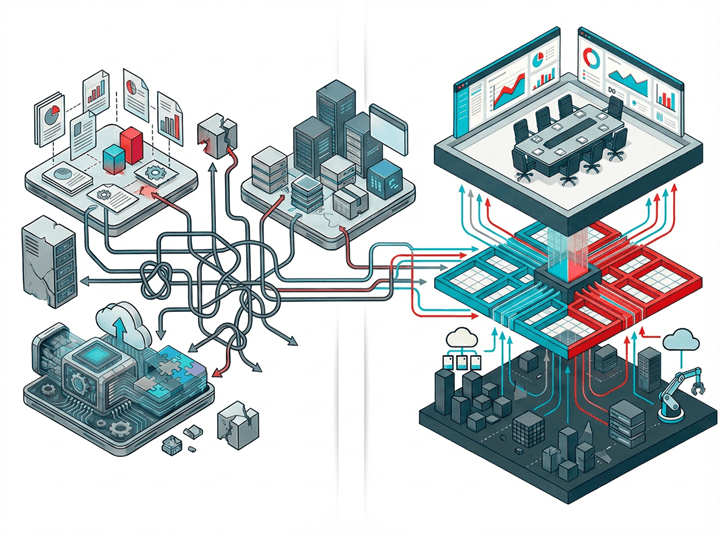
Technology strategy should not begin with technology.
It should begin with the difference the organisation wants to make.
That may include:
Growth
Better customer experience
Operational efficiency
Improved resilience
Faster innovation
Regulatory compliance
Expansion into new markets
Cost reduction
New products or services
Better employee experience
Transformation
These outcomes provide the context for every technology decision that follows.
The first question should therefore be:
What does the organisation need to become capable of doing?
Only then should the conversation move into systems, architecture and investment.
Once the desired outcome is clear, work backwards.
For example:
Business Outcome → Strategic Priority → Business Capability → Technology Requirement → Investment → Change
This creates a traceable relationship between the technology agenda and the reason it exists.
At Xirocco, we often describe this as the Golden Thread.
The principle is simple:
Every significant technology decision should be explainable in terms of the business capability and strategic outcome it supports.
Business capabilities create an important bridge between strategy and technology.
A strategic objective may be broad.
For example:
Improve customer experience.
That objective may depend on capabilities such as:
Customer insight
Personalisation
Digital self-service
Fulfilment
Service management
Data integration
Those capabilities may then depend on:
Applications
Data
Infrastructure
Architecture
Suppliers
Cybersecurity
Skills
This creates a much clearer line from strategic ambition to technology need.
Applications change.
Suppliers change.
Technology changes.
Capabilities are often more stable.
That makes them useful for connecting business and technology strategy.
For example:
Strategic Priority: Improve Operational Efficiency
may depend on:
Capability: Workforce Planning
which may depend on:
Application: Workforce Management Platform
which may depend on:
Data: Workforce and Demand Data
which may require:
Investment: Integration and Data Improvement
This creates a much stronger rationale for the investment.
The discussion moves from:
We need to upgrade this system
to:
This capability is critical to the strategic outcome, and the current system is constraining it.
Most organisations already have a significant technology estate.
The important question is not simply what exists.
It is:
How well does the current environment support the capabilities the organisation needs?
That means assessing:
Applications
Data
Infrastructure
Architecture
Cybersecurity
Suppliers
Technology capability
Operating model
against business relevance.
This makes it easier to identify:
Strategic strengths
Capability gaps
Technology constraints
Duplication
Risk
Misaligned spend
Areas requiring investment
Technology teams can identify hundreds of legitimate issues.
Examples might include:
Legacy systems
Unsupported infrastructure
Integration problems
Technical debt
Supplier concerns
Data quality
Security weaknesses
Architecture inconsistency
All may be real.
But they do not necessarily have equal strategic consequence.
Connecting them to business capabilities helps leadership understand which issues matter most.
For example:
A legacy system supporting a low-priority internal process may be manageable.
A similar system supporting a critical revenue capability may require urgent attention.
Context changes priority.
Business outcomes often depend on chains of technology and organisational dependencies.
For example:
Customer Growth → Digital Sales Capability → Application → Integration → Data → Infrastructure
or:
Operational Resilience → Critical Service → Application → Supplier → Infrastructure
or:
AI Adoption → Business Capability → Data → Cybersecurity → Architecture → Investment
If those dependencies are invisible, organisations can prioritise the right objective but fund the wrong thing.
A connected strategy makes the dependency chain visible.
Technical language alone can make strategic decisions harder.
For example:
Integration architecture is fragmented
may be true.
But it becomes more useful when translated into consequence:
Fragmented integration is slowing the launch of new digital services and increasing the cost of change.
Likewise:
Data quality is inconsistent
becomes:
Poor data quality is limiting customer insight and preventing reliable automation.
The technical issue has not changed.
The strategic meaning has become clearer.
A future technology state should not simply describe newer technology.
It should describe the technology capability required to support future business needs.
Questions should include:
Which capabilities need to improve?
Which need to become more scalable?
Which require better data?
Which depend on stronger resilience?
Which should be simplified?
Which need different suppliers?
Which require new architecture?
Which require changes in skills or operating model?
This ensures the target state is connected to the organisation's future rather than becoming a collection of technology preferences.
Technology strategies sometimes describe an idealised future estate that would take years to achieve.
That can create a gap between strategy and reality.
A more useful target state should distinguish between:
Strategic direction
Non-negotiable foundations
Near-term priorities
Longer-term evolution
The goal is not to design every future component in detail.
It is to create enough clarity to guide decisions consistently.
Technology outcomes depend on more than technology assets.
They also depend on how the organisation manages technology.
That may include:
Roles
Accountability
Governance
Architecture
Supplier management
Delivery
Investment
Skills
Business engagement
For example, an organisation may identify the need for stronger architecture.
But if architecture has little authority in the operating model, the strategy may not be deliverable.
Similarly, a supplier strategy may fail if vendor management capability is weak.
The operating model should therefore be treated as part of technology strategy.
A strategy becomes meaningful when it changes investment decisions.
Leadership should be able to ask:
Which investments support our most important capabilities?
Which are foundational?
Which can be deferred?
Which appear weakly aligned?
Which address several strategic priorities?
Which are required before other initiatives can succeed?
This creates a stronger basis for portfolio prioritisation.
It also helps explain why some less visible investments should be protected.
Some investments may have limited direct visibility but support several strategic outcomes.
Examples might include:
Data
Integration
Identity
Architecture
Cybersecurity
Infrastructure
Shared platforms
These investments can look less attractive when assessed independently.
But when dependencies are visible, their strategic value becomes clearer.
For example:
Data Foundation → Customer Analytics + AI + Automation + Regulatory Reporting
That is a much stronger investment story than:
Improve the data platform.
A technology roadmap should not simply be a list of projects by year.
Each major initiative should have a visible relationship to:
Strategic outcome
Business capability
Dependency
Risk
Investment
A useful roadmap might show:
Outcome → Required Capability → Current Gap → Initiative → Dependency → Timing
This helps leadership understand not just when something happens, but why.
The right initiatives in the wrong order can still produce poor results.
For example:
An organisation may want to deploy AI.
But if the AI agenda depends on:
Data improvements
Cybersecurity controls
Infrastructure
Integration
those foundations may need to be addressed first.
Similarly:
A customer transformation may depend on modernising a core application before front-end improvements can scale.
Connecting dependencies improves sequencing.
Technology strategy should also help answer where cost can be reduced.
Once applications, suppliers and investments are connected to business capability, leadership can identify:
Spend with weak strategic relevance
Duplicated applications
Overlapping suppliers
Avoidable future investment
Technology that can be consolidated
Costs that should be protected
This allows cost optimisation to emerge naturally from strategy.
The question becomes:
Where can we spend less without weakening the capabilities we need?
rather than:
Where can we cut a percentage?
Risk also becomes more meaningful when connected to business outcomes.
For example:
Cyber Vulnerability → Application → Critical Capability → Business Consequence
or:
Supplier Dependency → Application → Operational Service → Resilience Exposure
This helps leadership understand why one risk may deserve more attention than another.
Risk prioritisation becomes consequence-led rather than purely technical.
Transformation programmes often create their own technology agenda.
Over time, that agenda can drift away from the original business outcomes.
A connected technology strategy helps leadership continually ask:
Is this initiative still supporting the intended capability?
Has the business priority changed?
Are the original assumptions still valid?
Has a new dependency appeared?
Should investment be reprioritised?
This keeps transformation anchored to strategic intent.
A technology strategy depends on more than formal data.
It also depends on understanding why the organisation works the way it does.
Important context may include:
Why a legacy system remains
Why a supplier relationship is difficult to change
Where workarounds exist
Which capabilities depend on undocumented processes
Why previous transformation attempts struggled
Which investments carry organisational sensitivity
Where internal skills are concentrated
This information often exists in people's heads.
Capturing it improves the quality of the strategy.
A stronger technology strategy combines three forms of enterprise knowledge.
Formal information such as:
Applications
Suppliers
Infrastructure
Projects
Costs
Risks
Investments
Business capabilities
Structured assessment from:
Business leaders
Technology leadership
Enterprise architects
Cybersecurity specialists
Finance
Transformation teams
Procurement
Internal subject-matter experts
The context held in people's heads about:
Why decisions were made
Where hidden dependencies exist
Which systems are difficult to change
What workarounds exist
Which teams are stretched
Where previous initiatives failed
What the formal documentation does not show
This combination helps create a strategy grounded in how the organisation actually operates.
One test of a good technology strategy is whether a senior executive can understand why a major investment matters.
If the explanation requires several layers of technical detail, the strategic connection may be too weak.
For example:
Instead of:
We need to replace the integration platform.
Explain:
Our growth strategy depends on faster launch of new digital services. The current integration environment is slowing that capability and increasing delivery cost. Modernising it is therefore foundational to the growth agenda.
The technology decision is the same.
The business rationale is clearer.
Business strategy and technology strategy should not feel like separate documents.
They should tell one connected story.
That story should show:
What we want to achieve
↓
What capabilities we need
↓
Where current capability is weak
↓
What technology needs to change
↓
What investment is required
↓
What should happen first
This makes the strategy easier to communicate, govern and update.
Business priorities change.
Markets change.
Technology changes.
Suppliers change.
Costs change.
Risks change.
A technology strategy created once and presented as a static document can become outdated quickly.
The more useful model is continuous strategy.
That means preserving the context behind the strategy so leadership can revisit questions as conditions change.
For example:
Which investment should now move first?
What has changed in our capability gaps?
Which new risk affects our priorities?
Has a supplier change altered the roadmap?
Does a new AI opportunity require different foundations?
The strategy becomes a living decision capability.
Xirocco helps organisations connect business and technology context in one place.
That can include:
Business priorities
Capabilities
Applications
Data
Infrastructure
Architecture
Suppliers
Cybersecurity
Investment
Projects
Operating model
Risks
This allows relationships such as:
Business Priority → Capability → Application → Constraint → Investment
or:
Strategic Outcome → Capability Gap → Technology Change → Roadmap Action
or:
Transformation Objective → Required Capability → Supplier Dependency → Risk
The value is not simply documenting each component.
It is making the relationships visible.
Maeros AI can interrogate the connected enterprise context behind the strategy.
Questions might include:
Which technology weaknesses create the greatest constraint on our strategy?
Which capabilities depend on the most fragile technology?
Which investments support multiple strategic priorities?
Where is spend weakly aligned with business outcomes?
Which supplier dependencies create the greatest strategic exposure?
What would happen if this investment were deferred?
Which technology changes should happen first?
Where are the most important capability gaps?
The ability to ask follow-up questions helps leadership explore the reasoning behind the strategy rather than relying on a static roadmap.
A practical way to connect technology strategy to business outcomes is:
Define the outcomes the organisation wants to achieve
Identify the business capabilities required
Assess how well current technology supports those capabilities
Identify the most important gaps and constraints
Make dependencies visible
Define the target direction
Connect required changes to investment
Sequence the roadmap
Connect operating-model changes
Preserve the context so the strategy can evolve
This creates a traceable line from strategic ambition to practical technology action.
A good technology strategy should make it possible to answer:
Why are we doing this?
for every significant technology initiative.
The answer should not simply be:
The system is old
The vendor recommends it
The architecture team prefers it
The technology is modern
The project was already in the plan
The answer should connect back to:
Business outcome
Capability
Risk
Strategic dependency
Required investment
When that relationship is visible, technology strategy becomes easier to prioritise, explain and govern.
A strategy should make the relationship between business ambition, capability, technology, investment and change visible.
If that connection is difficult to explain, that is usually the place to start.
Start a Conversation
Share what is on your agenda and we'll explore, without obligation, whether we can help.